
Published in Firm News on July 1, 2026
Australia has the Flying Doctor Service. Douglas, Haun & Heidemann has the Flying Lawyer. Me.
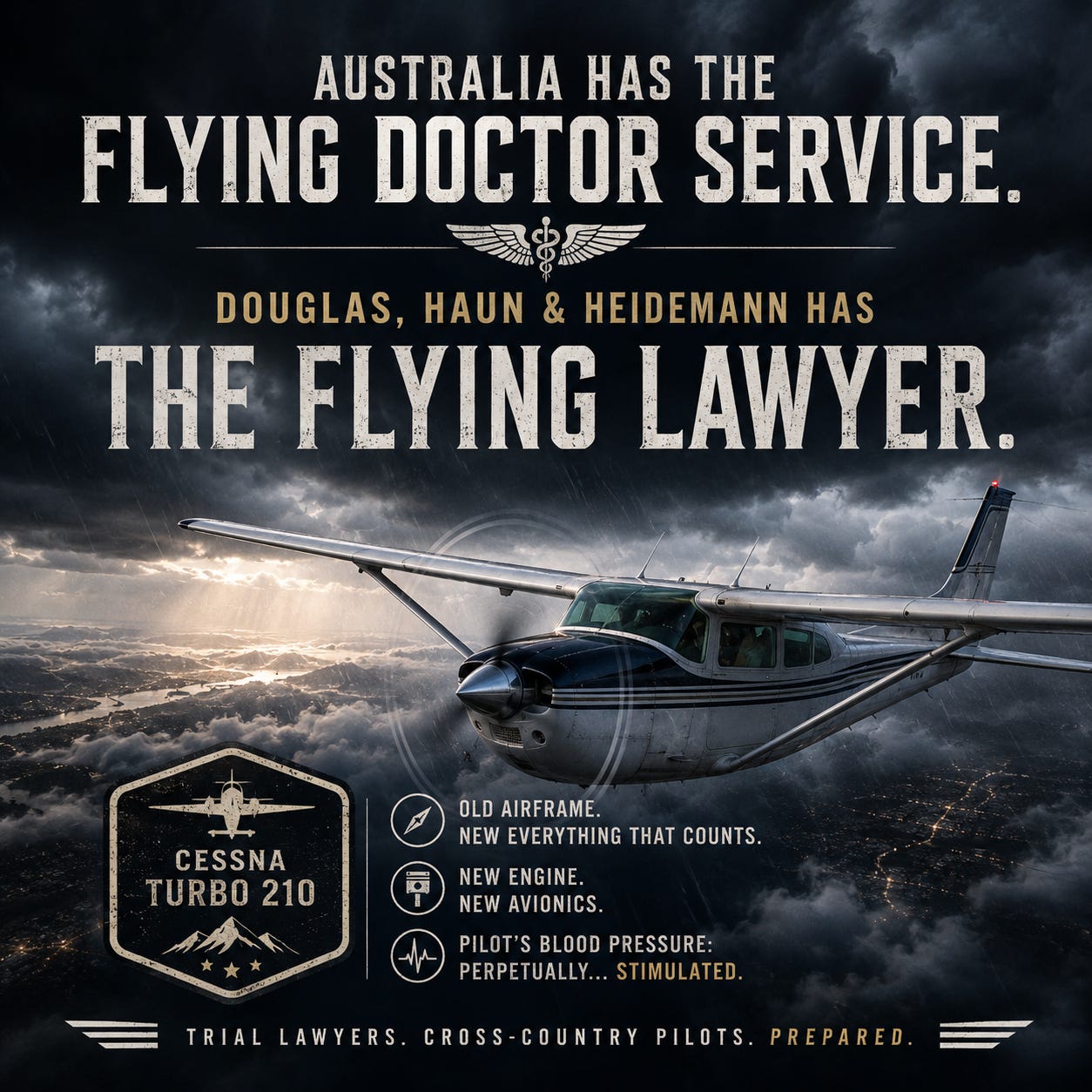
Flying a 1980 aircraft is always an adventure. The airframe may be old, but the engine is new, the avionics are new, and the pilot’s blood pressure is perpetually… stimulated.
The airplane is a Cessna Turbo 210. Six seats, single engine, turbocharged, brand new engine. Not cheap as you might guess bit its necessary. It is a serious cross-country machine, and today it earned every dollar we put into it.
At cruise I was by myself making 198 knots across the ground, roughly 228 miles per hour, with about 18 knots of tailwind push helping me along. Call it three and a half to four miles every minute. When things start happening in that airplane, they happen fast.
My dad was a flight instructor. One of the first things he taught me was to think ahead of the airplane, not with it. Ahead of it. The more performance you build into an airplane, the faster you have to think. A Turbo 210 at cruise does not wait for you to catch up. You have already planned for what comes next, or you are behind, and behind is a bad place to be when the GPS quits in the clouds. We pilots have a saying, “don’t be behind the airplane.“
Earlier in the flight, before any of this started, I had turned the autopilot off and hand flew for a while. Not because anything was wrong. Because you cannot always rely on the autopilot, and if you stop practicing, you stop being ready. When your bandwidth is fully consumed and you are managing a GPS failure and a failed probe and an approach controller asking questions, and the threat of ice, that is when spatial disorientation can rush in. That is when pilots lose control of an aircraft they could have saved. It is a real problem in general aviation and it kills people. So you practice. You stay sharp.
Take today. Springfield to lower Michigan, in actual instrument meteorological conditions. Solid clouds, no horizon, nothing but gray. Somewhere over the route, the primary GPS quit. Not an emergency. The GI 275 has its own built-in backup. But there is a saying in the world I live in: two is one, and one is none. I had one.
Then the number six exhaust gas temperature probe failed. Still not an emergency. The engine was running fine. But my mind was keeping score: that is two things. Two things that were working this morning. PS – annual inspection starts July 1
My working theory on the GPS: the driving rain. We were flying through conditions I do not normally seek out, and rain has a way of finding antenna connections it was never supposed to reach. The wings do not care if it is raining. The antenna connections apparently do.
Speaking of rain finding places it was not supposed to be: it was also seeping in through the baggage area, driven by the suction the fuselage creates in flight, spraying across my luggage and the deposition files stacked in the back for tomorrow’s expert witnesses. A medical malpractice case. The files got slightly damp, somewhere over Indiana. That’s what you get with nearly 50 year-old door seals
People ask why I flew into it. Fair question. The answer is that I checked before I ever left Springfield. This was not convective activity. No thunderstorms, no embedded cells, nothing that would make a prudent proficient pilot turn around or stay home. This was a Great Lakes moisture system that built up over Michigan and entered the state with its chest puffed out, more than it looked like on departure. Rain, yes. A lot of it. But rain the wings can handle.
What the wings handle, the cockpit sometimes does not. Water was finding its way in and dripping down onto my left knee. I got my rag out and dealt with it.
None of it was dangerous in the way non-pilots imagine. It was just used a lot of my bandwidth. Every system on the airplane working, the pilot working, and not a lot of margin for anything else. It was spicy!
Some of you saw my Facebook post the other night. I went out and flew six instrument approaches in the dark. Night currency. Instrument proficiency. Not because I had somewhere to go. Because that is why we train.
So that when the GPS quits at 11,000 feet in driving rain, it is not an emergency. It is just Thursday mor me.
Do I prefer flying in those conditions? Of course not. Is it a big deal when it happens? No. Does working through it make you a better pilot? Yes. Can you handle it safely if you have put in the work? Of course.
A lot of pilots do not put in that work. They do not always end up with a good outcome.
Through all of it, the Garmin autopilot flew the airplane. Steady. Reliable. My partner and I have invested in top-notch equipment. Today it worked. The autopilot held the airplane while I dealt with everything else. That is exactly what it is supposed to do, and I was grateful for every second of it.
When the primary GPS quit, I had another problem beyond the obvious one. The whole approach sequence into Grand Rapids was loaded in ForeFlight on the iPad, but ForeFlight needs a GPS feed to display it. No GPS, no moving map, no approach guidance on the iPad. That is why I needed the puck. For all you pilots out there, I confesses my problem and told ATC I lost my GPS and I was in heading mode. So don’t judge me. A lot of pilots are too afraid to confess their problems. I’m not that guy.
I also had to figure out how to enter the waypoint manually into the GI 275, a function we almost never use. It was not hard. Once I had it in, I realized it would get me to the next fix, which was enough. The puck would handle the rest once it came to life.
I reached into the flight bag and pulled out my Dual GPS puck. Little thing, about the size of a hockey puck, twenty-something dollars on Amazon. Its battery was dead. I plugged it into my backup battery pack and it came instantly to life, pulling signals from American GPS satellites and the Russian GLONASS constellation simultaneously, feeding fresh position data straight into ForeFlight on the iPad via Bluetooth. Two is one, and one is none. Now I had two again: one to rely on, and one to save your life.
Approach wanted the GPS 26 Left into Grand Rapids. I told them what I had already told them: GPS unreliable, ILS only. They acknowledged.
Then came the thing that concerned me most of all: ice.
I was at 11,000 feet in driving rain with the outside air temperature reading 33 degrees. Pitot heat on. Defrost cranking. Ice is the one that gets you. It builds on the wings and changes everything about how they fly, and then they do not fly at all. Icicles do not fly. Every mile further north was another degree colder, and I was already thinking about exercising my emergency authority to descend on my own initiative. A pilot does not need permission to declare an emergency. Sometimes you just go.
They gave me lower. I descended. It got warmer. The ice stayed away.
The primary GPS eventually came back. I did not switch off the ILS to use it. When you are 200 feet above the ground in driving rain, you do not change anything. You fly what you have. If that GPS had gone out again on short final I would have been hand flying an instrument approach with no panel GPS and no room for error. The ILS does not care what the weather is doing. You follow the needles. You land.
They turned me onto the ILS final and asked if I had the traffic ahead in sight.
I was in the clouds. In driving rain.
I flew the approach. I broke out. I landed.
Just another day in general aviation.
People make fun of me for carrying all of it. The backup GPS puck. The charging cables. The extra battery pack. The bag of stuff that nobody thinks they are ever going to need because none of that weird stuff ever happens.
Until it does.
At 11,000 feet, in driving rain, 33 degrees outside, with a dead primary GPS and an approach controller asking questions, that bag of so-called crap was the most valuable thing on the airplane. I had the last laugh.
I did not need the U.S. Army lensatic compass attached to the outside of the bag. When you need that, you have had a genuinely bad day.
Where did all of this come from? I have been thinking about that.
My dad sent me a picture recently of my good friend Chris Davis. Chris and I earned our Eagle Scout together. We went to law school together. We were together all the time. He died several years ago. He was my best friend and I miss him every day.
Chris’s father, Mr. Davis, was our Scoutmaster. I can still remember standing in his garage next to a 1955 Chevrolet while he taught me to tie a knot. The language he used to describe where the rope needed to go has never left me. I will leave that to your imagination. He showed up for every campout. He was that kind of man. Between him and my dad, I did not lack for men who showed up and taught you things that stuck.
I posted the picture on Facebook and someone commented: do a good turn daily. That is the Scout Slogan. I responded with two words: be prepared. That is the Scout Motto.
One tells you how to treat people. The other tells you how to face whatever comes.
Both of them served me well today at 11,000 feet over Indiana. Both of them will serve you well tomorrow, wherever you are.
Bring the bag.
—
Craig Heidemann is a trial lawyer and partner at Douglas, Haun & Heidemann, P.C., in Springfield and Bolivar, Missouri. He practices personal injury, medical malpractice, and civil rights law. He also flies himself to depositions.